
En komparativ analyse av Seeds of Hope Ploughshares (1996) og Palestine Action (2020–2026)

Henning Økland
1. Denne artikkelen undersøker hvordan britiske myndigheter har håndtert to sentrale saker om direkte aksjon mot våpenindustrien:
Seeds of Hope Ploughshares (1996) og Palestine Action (2020–2026). Begge sakene springer ut av forsøk på å hindre våpeneksport til stater anklaget for alvorlige menneskerettighetsbrudd. Til tross for betydelige likheter i motivasjon og metode, har de to sakene fått radikalt ulike rettslige utfall. Analysen viser hvordan endringer i britisk lovverk, særlig Terrorism Act 2000, samt forskjellen mellom jurybehandling og domstolsbehandling, har skapt et nytt juridisk landskap for politisk motivert sivil ulydighet.
Et sentralt poeng i denne artikkelen er folkerettslige vurderinger av statlig medvirkning til krigsforbrytelser, folkemord og brudd på menneskerettigheter med særlig henblikk på hvordan det er formulert av FNs spesialrapportør Francesca Albanese. Dette er vesentlig når man ser hvordan staten strategisk håndterer Palestine Action.
2. Seeds of Hope Ploughshares (1996).Juryens rom for samvittighet og vurdering av motiv:
I januar 1996 brøt fire aktivister — Andrea Needham, Joanna Wilson, Lotta Kronlid og Angie Zelter — seg inn i BAE Systems’ fabrikk i Warton, Lancashire, og påførte omfattende materiell skade på et Hawk‑jagerfly under produksjon. Flyet var kontraktfestet for eksport til Indonesia, som på dette tidspunktet var internasjonalt kritisert for alvorlige menneskerettighetsbrudd i Øst‑Timor (Amnesty International, 1995).
Under rettssaken aksepterte juryen aktivistenes argument om «lawful excuse»: at handlingen var nødvendig for å forhindre større skade. Juryen frikjente dem fullstendig. Denne frifinnelsen er et sjeldent eksempel på juryens demokratiske prerogativ til å nullifisere loven — en mekanisme som gir rom for moralske vurderinger i straffesaker (Green, 2001).
3. Palestine Action (2020–2026): Domstolens rom for lovens ordlyd.
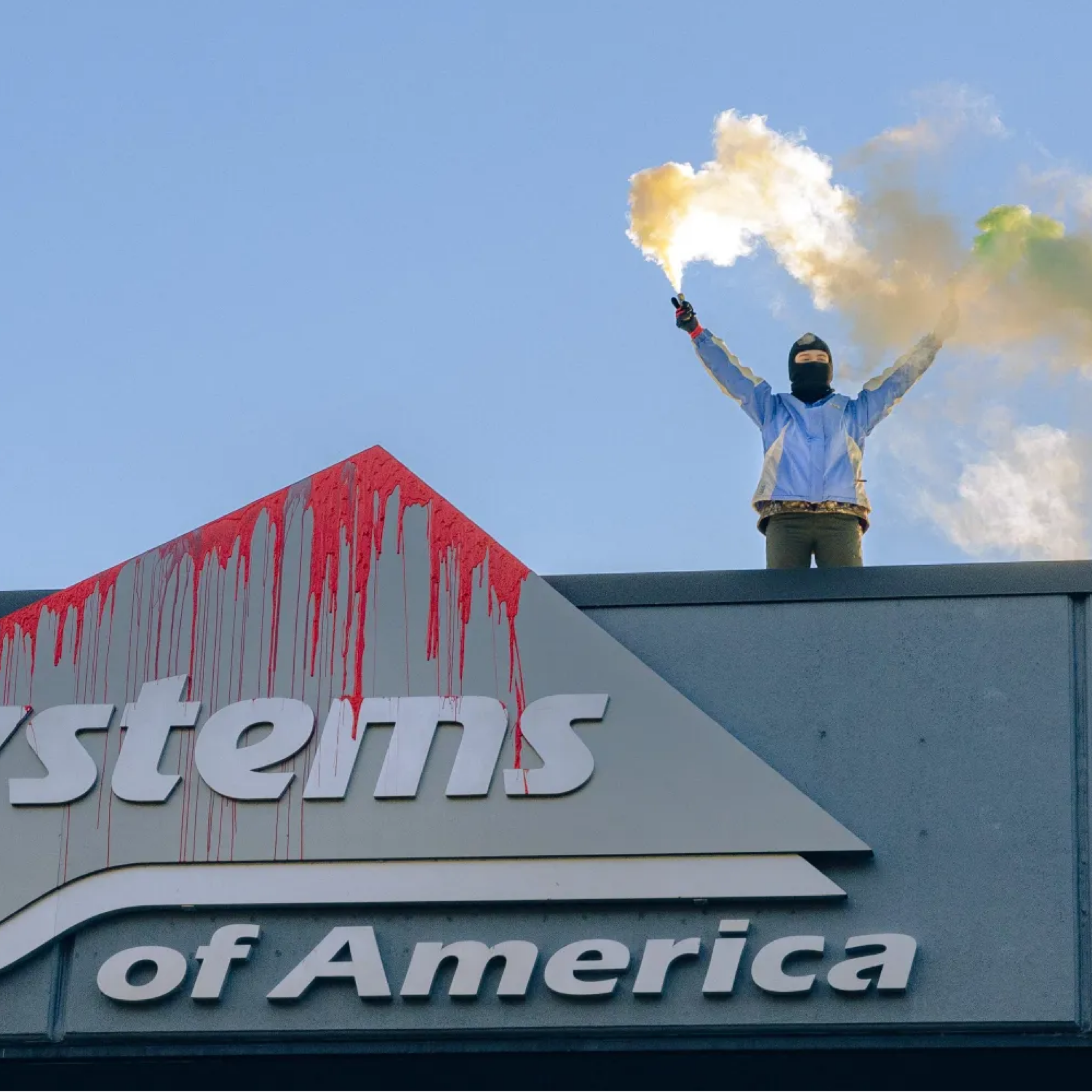
Palestine Action er en desentralisert britisk bevegelse som siden 2020 har gjennomført direkte aksjoner mot Elbit Systems’ britiske anlegg. Elbit Systems er Israels største private forsvarsleverandør, og har vært gjenstand for omfattende kritikk fra menneskerettighetsorganisasjoner for sin rolle i militære operasjoner i Gaza (Human Rights Watch, 2021). Aktivistene påpeker at britisk våpeneksport bidrar til alvorlige menneskerettighetsbrudd i Gaza. Aksjonene har inkludert okkupasjoner, blokkader og materiell skade på militært utstyr. I 2025 ble bevegelsen klassifisert som en terrororganisasjon av britiske myndigheter. Over 3 500 personer er arrestert i tilknytning til bevegelsen. Rettssystemet har gitt sprikende vurderinger: High Court konkluderte i februar 2026 med at forbudet var ulovlig, mens Court of Appeal i juni 2026 opprettholdt forbudet. Saken skal behandles av Supreme Court i siste kvartal av 2026.
4. Terrorism Act 2000: Et nytt juridisk regime fra staten for å kontrollere politisk protest:
Terrorism Act 2000 representerer et strukturelt brudd med tidligere britisk lovgivning. Før 2000 var terrorbegrepet smalt og primært knyttet til vold mot sivile. Etter lovens innføring ble definisjonen betydelig utvidet til å omfatte alvorlig skade på eiendom, handlinger som skaper omfattende samfunnsforstyrrelser, og handlinger som har politisk, ideologisk eller religiøst motiv (UK Home Office, 2000). Loven gir regjeringen adgang til å forby organisasjoner som anses å “fremme eller oppfordre til terrorhandlinger”. Den kriminaliserer også støtte til slike organisasjoner, inkludert symbolbruk og deltakelse i møter. Videre gir loven politiet utvidede fullmakter til ransaking uten mistanke, beslag av elektronisk utstyr og arrestasjon uten tiltale. Prinsippet om «lawful excuse», som var avgjørende i Ploughshares‑saken, er sterkt begrenset i saker som faller under terrorlovgivningen. Motivasjon — selv når den er knyttet til menneskerettighetsvern — er juridisk irrelevant i terrorsaker.
5. Jury versus domstol: To rettslige rom, to politiske virkemidler, demokrati versus oligarki:
Forskjellen mellom jurybehandling og domstolsbehandling er avgjørende for å forstå de ulike utfallene. Juryen i Ploughshares‑saken kunne vektlegge motiv, kontekst og etiske begrunnelser. Den kunne nullifisere loven og frikjenne aktivistene på moralsk grunnlag. Domstoler har ikke dette rommet. De er bundet av lovens ordlyd og presedens. Etter Terrorism Act 2000 må domstoler vurdere handlinger ut fra lovens brede definisjon av terrorisme, uavhengig av motiv. Dermed vurderes Palestine Action ikke som samvittighetsaktivister, men som en organisasjon som faller inn under terrorlovgivningen. Dette skaper en asymmetri: Ploughshares ble vurdert av folket; Palestine Action vurderes av staten.
6. Medansvar/medvirkning og svekkelse av statens moralske legitimitet: Albaneses folkerettslige rammeverk:
Francesca Albanese, FNs spesialrapportør for menneskerettighets-situasjonen i de okkuperte palestinske områdene, har i flere rapporter understreket at stater kan holdes ansvarlige for medvirkning (complicity) til krigsforbrytelser og folkemord dersom de “bidrar, tilrettelegger, beskytter, forsyner eller unnlater å forhindre” Israels handlinger i Gaza (OHCHR, 2024). I rapporten Gaza Genocide: A Collective Crime skriver hun at folkemordet er “sustained by the complicity of influential Third States” (UN General Assembly, 2024). Dette bygger på ICJs praksis om staters plikt til å forhindre folkemord (ICJ, Bosnia v. Serbia, 2007) og ILCs Draft Articles on State Responsibility art. 16. Denne folkerettslige rammen har direkte relevans for britisk kontekst. Dersom britiske myndigheter anses å bidra til eller tilrettelegge for folkerettsstridige handlinger gjennom våpeneksport, blir Palestine Actions aksjoner ikke bare en kritikk av en privat forsvarsleverandør, men en utfordring mot statens legitimitet som forvalter av menneskerettigheter og internasjonale forpliktelser.
Nettopp dette skaper et «politisk insentiv» for staten til å behandle saken under Terrorism Act 2000. Slik fjerner staten motivet — som i Ploughshares‑saken var avgjørende for frifinnelse, fra den rettslige vurderingen. Domstolsbehandling, i motsetning til jurybehandling, gjør det mulig for staten å unngå en offentlig vurdering av sitt potensielle folkerettslige medansvar.
7. Historisk kontekst: 1948 og britisk ansvar:
Den palestinske historien er uløselig knyttet til 1948, da etableringen av staten Israel og den påfølgende krigen førte til fordrivelsen av over 700 000 palestinere — kjent som al‑Nakba (Pappé, 2006). Storbritannia, som mandatmakt, spilte en sentral rolle i de politiske prosessene som ledet frem til konflikten.Denne historiske konteksten er relevant for dagens debatt om britisk våpeneksport og statlig medvirkning til menneskerettighetsbrudd. Ploughshares‑saken og Palestine Action‑saken illustrerer hvordan juridiske strukturer, politiske kontekster og folkerettslige rammer former statens respons på sivil ulydighet. Der Ploughshares ble frikjent av en jury som kunne vektlegge motiv, vurderes Palestine Action av domstoler som må følge et lovverk som etter 2000 gir staten vidtrekkende fullmakter.
Når folkerettslige vurderinger av statlig complicity/medvirkning samtidig utfordrer statens legitimitet, får saken en ekstra politisk dimensjon: domstolsbehandling blir et «strategisk verktøy» for staten, for å fjerne motivet fra rettsprosessen og dermed beskytte staten mot implisitt medansvar.
Supreme Courts kommende avgjørelse vil få betydning langt utover én organisasjon. Den vil berøre demokratiets grenser, protestrettens fremtid og statens rolle i internasjonale menneskerettighetsregimer.
Kilder
Amnesty International (1995). Indonesia and East Timor: Human Rights Violations.
Green, T. (2001). Jury Nullification and Democratic Theory. Oxford University Press.
Human Rights Watch (2021). Israel/Palestine: Events of 2020.
ICJ (2007). Case Concerning the Application of the Convention on the Prevention and Punishment of the Crime of Genocide (Bosnia v. Serbia).
ILC (2001). Draft Articles on State Responsibility.
OHCHR (2024). Report of the Special Rapporteur on the situation of human rights in the Palestinian territories occupied since 1967.
Pappé, I. (2006). The Ethnic Cleansing of Palestine. Oneworld Publications.
UK Home Office (2000). Terrorism Act 2000.
UN General Assembly (2024). Gaza Genocide: A Collective Crime.
Civil disobedience, human rights and the limits of the rule of law
A comparative analysis of Seeds of Hope Ploughshares (1996) and Palestine Action (2020–2026)
Henning Økland
1. This article examines how the British authorities have handled two key cases involving direct action against the arms industry:
Seeds of Hope Ploughshares (1996) and Palestine Action (2020–2026). Both cases stem from attempts to prevent arms exports to states accused of serious human rights violations. Despite significant similarities in motivation and method, the two cases have resulted in radically different legal outcomes. The analysis demonstrates how changes to UK legislation, particularly the Terrorism Act 2000, as well as the difference between jury trials and court trials, have created a new legal landscape for politically motivated civil disobedience.
A key point in this article is the assessment under international law of state complicity in war crimes, genocide and human rights violations, with particular reference to how this has been formulated by the UN Special Rapporteur, Francesca Albanese. This is significant when considering how the state is strategically dealing with Palestine Action.
2. Seeds of Hope Ploughshares (1996). The jury’s scope for exercising conscience and assessing motive:
In January 1996, four activists — Andrea Needham, Joanna Wilson, Lotta Kronlid and Angie Zelter — broke into BAE Systems’ factory in Warton, Lancashire, and caused extensive material damage to a Hawk fighter jet under production. The aircraft was contracted for export to Indonesia, which at that time was facing international criticism for serious human rights abuses in East Timor (Amnesty International, 1995).
During the trial, the jury accepted the activists’ argument of ‘lawful excuse’: that the action was necessary to prevent greater harm. The jury acquitted them entirely. This acquittal is a rare example of the jury’s democratic prerogative to set aside the law — a mechanism that allows for moral judgements in criminal cases (Green, 2001).
3. Palestine Action (2020–2026): The court’s scope for the letter of the law.
Palestine Action is a decentralised British movement which, since 2020, has carried out direct actions against Elbit Systems’ British facilities. Elbit Systems is Israel’s largest private defence contractor and has been the subject of widespread criticism from human rights organisations for its role in military operations in Gaza (Human Rights Watch, 2021). The activists point out that British arms exports contribute to serious human rights violations in Gaza. The actions have included occupations, blockades and the causing of material damage to military equipment. In 2025, the movement was classified as a terrorist organisation by the British authorities.
Over 3,500 people have been arrested in connection with the movement. The judicial system has delivered conflicting rulings: in February 2026, the High Court concluded that the ban was unlawful, whilst in June 2026 the Court of Appeal upheld the ban. The case is due to be heard by the Supreme Court in the final quarter of 2026.
4. Terrorism Act 2000: A new legal framework introduced by the state to control political protest:
The Terrorism Act 2000 represents a structural break with previous British legislation. Prior to 2000, the concept of terrorism was narrow and primarily linked to violence against civilians. Following the Act’s introduction, the definition was significantly broadened to include serious damage to property, acts causing widespread public disorder, and acts motivated by political, ideological or religious reasons (UK Home Office, 2000). The Act empowers the government to ban organisations deemed to “promote or incite acts of terrorism”. It also criminalises support for such organisations, including the display of symbols and attendance at meetings. Furthermore, the Act grants the police extended powers to carry out searches without suspicion, seize electronic equipment and make arrests without charge. The principle of ‘lawful excuse’, which was decisive in the Ploughshares case, is severely restricted in cases falling under anti-terrorism legislation. Motivation — even when linked to the defence of human rights — is legally irrelevant in terrorism cases.
5. Jury versus court: Two legal spheres, two political instruments, democracy versus oligarchy:
The difference between jury trials and court proceedings is crucial to understanding the different outcomes. The jury in the Ploughshares case was able to take into account motive, context and ethical justifications. It could set aside the law and acquit the activists on moral grounds. Courts do not have this leeway. They are bound by the letter of the law and precedent. Under the Terrorism Act 2000, courts must assess actions based on the law’s broad definition of terrorism, regardless of motive. Consequently, Palestine Action is not regarded as a group of conscientious objectors, but as an organisation falling under anti-terrorism legislation. This creates an asymmetry: Ploughshares was judged by the people; Palestine Action is judged by the state.
6. Joint responsibility/complicity and the erosion of the state’s moral legitimacy: Albanese’s framework under international law:
Francesca Albanese, the UN Special Rapporteur on the situation of human rights in the Occupied Palestinian Territories, has emphasised in several reports that states can be held responsible for complicity in war crimes and genocide if they “contribute to, facilitate, protect, supply or fail to prevent” Israel’s actions in Gaza (OHCHR, 2024). In the report *Gaza Genocide: A Collective Crime*, she writes that the genocide is “sustained by the complicity of influential Third States” (UN General Assembly, 2024).
This is based on the ICJ’s case law regarding states’ duty to prevent genocide (ICJ, Bosnia v. Serbia, 2007) and Article 16 of the ILC’s Draft Articles on State Responsibility. This framework of international law is directly relevant to the British context. If the British authorities are deemed to be contributing to or facilitating acts contrary to international law through arms exports, Palestine Action’s campaigns become not merely a criticism of a private defence contractor, but a challenge to the state’s legitimacy as the guardian of human rights and international obligations.
It is precisely this that creates a ‘political incentive’ for the state to prosecute the case under the Terrorism Act 2000. In this way, the state removes the motive — which, in the Ploughshares case, was decisive for the acquittal — from the legal assessment. A trial before a judge, as opposed to a trial by jury, enables the state to avoid a public assessment of its potential joint responsibility under international law.
7. Historical context: 1948 and British responsibility:
Palestinian history is inextricably linked to 1948, when the establishment of the State of Israel and the ensuing war led to the displacement of over 700,000 Palestinians — known as al-Nakba (Pappé, 2006). The United Kingdom, as the Mandatory Power, played a central role in the political processes leading up to the conflict. This historical context is relevant to the current debate on British arms exports and state complicity in human rights violations. The Ploughshares case and the Palestine Action case illustrate how legal structures, political contexts and the framework of international law shape the state’s response to civil disobedience. Whilst Ploughshares were acquitted by a jury able to take motive into account, Palestine Action is being assessed by courts that must adhere to legislation which, since 2000, has granted the state far-reaching powers.
When assessments under international law of state complicity challenge the state’s legitimacy, the case takes on an additional political dimension: court proceedings become a ‘strategic tool’ for the state, designed to remove the issue of motive from the legal process and thereby protect the state from implicit complicity.
The Supreme Court’s forthcoming decision will have implications far beyond a single organisation. It will touch upon the limits of democracy, the future of the right to protest and the state’s role in international human rights regimes.
Sources
Amnesty International (1995). Indonesia and East Timor: Human Rights Violations.
Green, T. (2001). Jury Nullification and Democratic Theory. Oxford University Press.
Human Rights Watch (2021). Israel/Palestine: Events of 2020.
ICJ (2007). Case Concerning the Application of the Convention on the Prevention and Punishment of the Crime of Genocide (Bosnia v. Serbia).
ILC (2001). Draft Articles on State Responsibility.
OHCHR (2024). Report of the Special Rapporteur on the situation of human rights in the Palestinian territories occupied since 1967.
Pappé, I. (2006). The Ethnic Cleansing of Palestine. Oneworld Publications.
UK Home Office (2000). Terrorism Act 2000.
UN General Assembly (2024). Gaza Genocide: A Collective Crime.