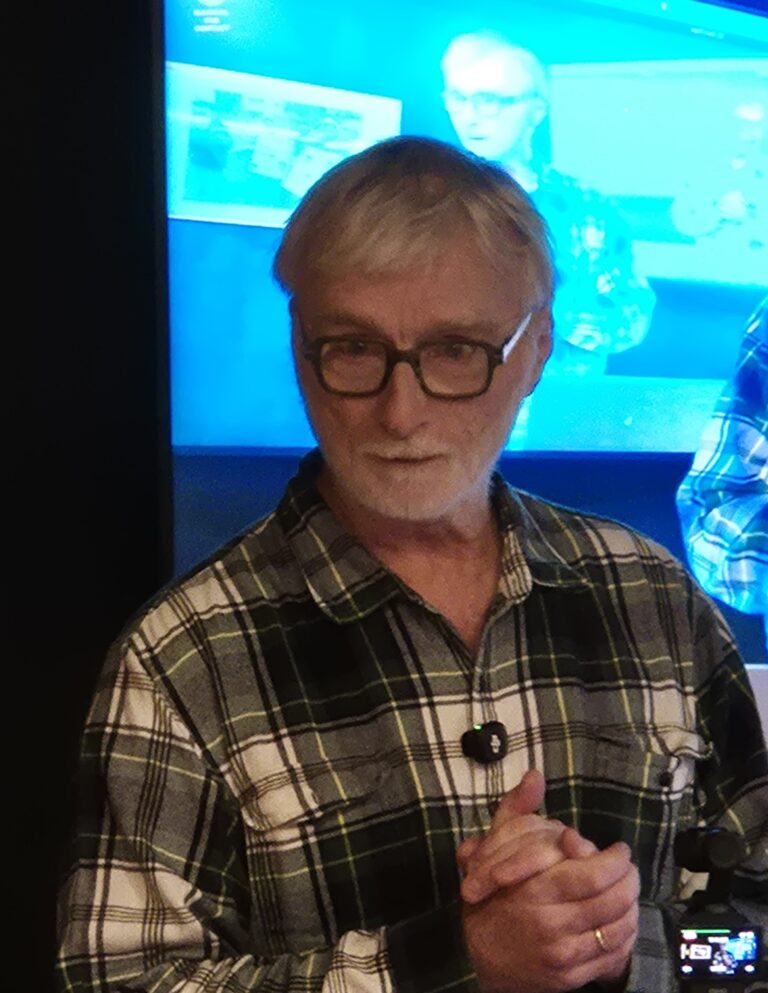
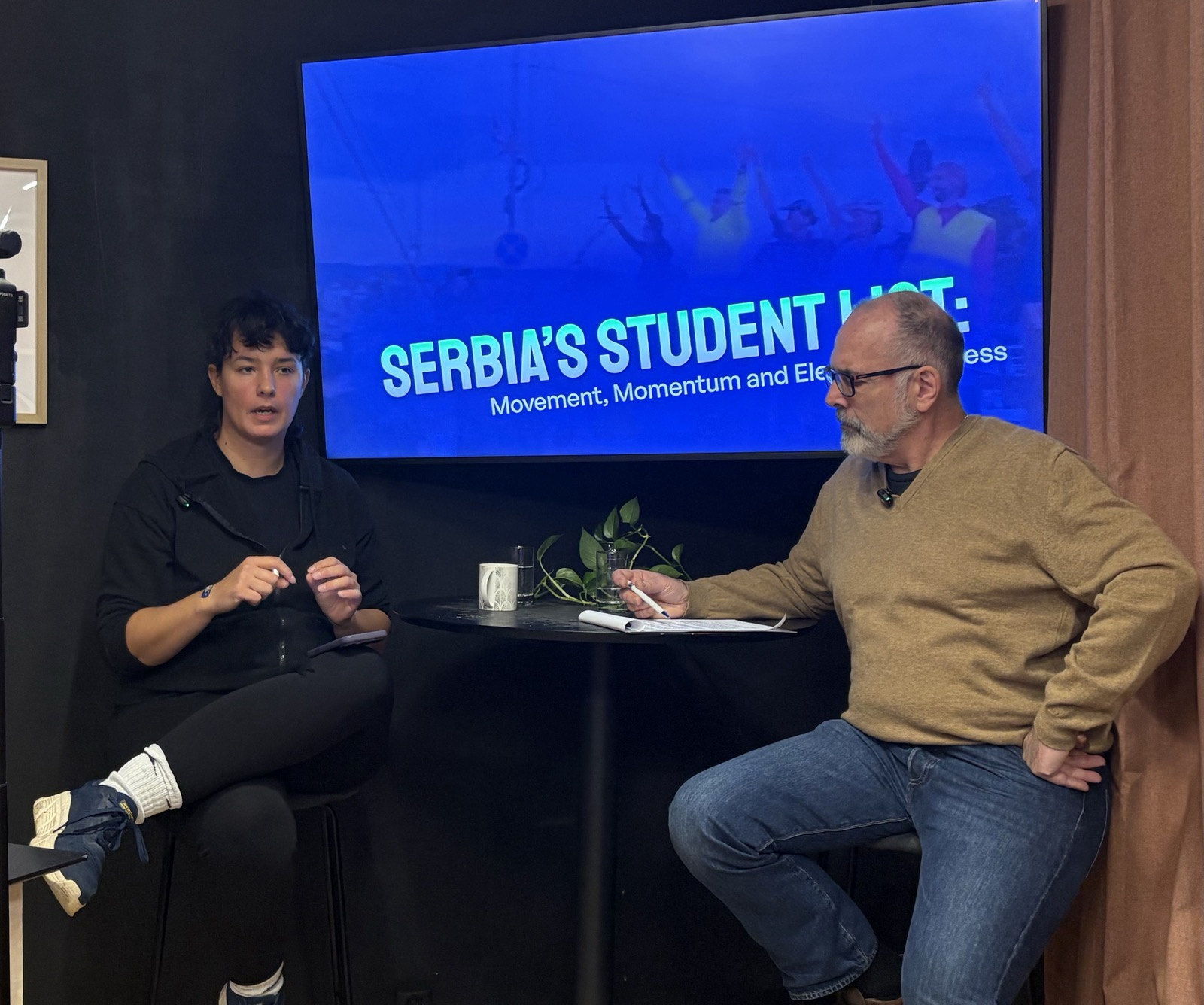
Sunday 8 November 2026, 14:00–16:00 · FOR-huset, Olafiagangen 3, Oslo Jelena Veljić with Peter Eisenstein and Marielle Leraand
FOR members and others interested in Serbia gathered at FOR-huset to hear Jelena Veljić explain the Student List phenomenon. Jelena is a former political activist who knows what it takes to organise from the ground up. Today she is a political commentator and a close observer of how the student movement has evolved.
Some participants came sceptical about whether the political upheaval in Serbia was authentic. We hope the conversation left everyone better informed on the topic.
Below is the first part of the conversation, between Peter Eisenstein and Jelena Veljić. The transcript has been lightly edited for readability.
From the Radical Party to the Progressive Party
Peter Eisenstein: Hello and welcome to this discussion on the Student List in Serbia, organised by Partiet FOR. We have the honour of having Jelena Veljić with us today. She was a longtime peace activist in Serbia and has now lived in Norway for a number of years. She is here to give us some background on what has been going on in Serbia. Afterwards, Marielle Leraand, our party leader, will join to explore how events in Serbia might inform and inspire us here in Norway, and maybe in other Nordic countries as well.
Jelena, welcome.
Jelena Veljić: Thank you very much for inviting me.
Peter Eisenstein: Thank you very much for coming. Vučić, who has now been overthrown, was in power for 14 years, and the Student List has done a tremendous job. I think it’s not so much a movement as a phenomenon now. Even though Vučić has been in power for 14 years, he was involved in Serbian politics for much longer than that. He was Minister of Information under Milošević from 1998 to 2000, I believe.
Jelena Veljić: Yes.
Peter Eisenstein: How did he survive in Serbian politics after Milošević was ousted, when he had been one of the main members of his government?
Jelena Veljić: To answer that, I have to go back a little and give some context on Serbia. As you know, the collapse of the Eastern Bloc at the end of the 1980s also brought the collapse of Yugoslavia, which dissolved in total bloodshed.
At the beginning of the 1990s, nationalism had been fuelled for many years, and privatisation was happening in parallel with the dissolution of the whole country. In that period there were a lot of very hopeless people, and it was not difficult to direct them toward some of the most destructive political forces of the time. The multi-party system was introduced then as well. Some of those forces were extreme right-wing parties and groups connected to the paramilitary groups that operated in the Yugoslav wars. That happened on other sides too, but since we are talking about Serbia, it’s important to mention that the Serbian paramilitary forces were connected to some of the parties that emerged in Serbia at that time.
During the war, the right-wing groups were the most active. One of them was the Serbian Radical Party, led by Vojislav Šešelj, and Aleksandar Vučić was there from the moment the party was formed. I wrote down some statistics. This is a short summary of a very complex context, but because of these circumstances the Serbian Radical Party had its own voter base from the early 1990s. In the 1992 elections they won 24%, in 1993 14% and in 1997 29%. That base is how they got into government with Milošević at the end of the 1990s.
After 2000, there was none of the lustration everybody had promised, no barring of people involved in such destructive politics from political work. They were not prosecuted, and they were not barred from politics. So the Serbian Radical Party continued to exist and retained its base.
Around 2008 the party leadership split. Vojislav Šešelj and his people remained the Serbian Radical Party, while Aleksandar Vučić and Tomislav Nikolić left and formed the Serbian Progressive Party. They rebranded themselves as modern, EU-style right-wing conservatives rather than extreme nationalists.
Peter Eisenstein: But were they pro-EU?
Jelena Veljić: At the time they were not as explicitly pro-EU as some of the democratic parties in Serbia, but they were heading in that direction. You could literally see the change in their appearance, in their talking points and a little in their politics. In the end it wasn’t a real change, but they rose to power on that rebranded image.
Serbia’s political system, media and opposition
Peter Eisenstein: My understanding is that Vučić was already at the end of his presidency. He was constitutionally barred from running again, so he resigned even before the parliamentary elections. Apparently his plan was to win enough seats to become prime minister.
Jelena Veljić: Yes.
Peter Eisenstein: And thankfully that backfired, because the Student List won such a resounding victory. Can you describe the political system in Serbia?
Jelena Veljić: Yes. It is a parliamentary republic of the classic type, with three branches: legislative, executive and judicial. Elections are held at three levels: parliamentary elections, local elections for local assemblies, and presidential elections.
Everybody can run for election if they meet some requirements, such as being a citizen and over 18. To form a political party, you have to gather 10,000 verified signatures. That is relatively easy, but having every signature verified costs money. You can also run as a group of citizens, with the same requirement to gather signatures of support. That is how the system looks structurally.
As for the context just before this last election: most of the media is controlled by the government. Some outlets are state-owned and some are privately owned, but the owners are connected to the ruling party. The independent media, which are mostly liberal, struggle with their reach because of irregularities in how channels and signals are distributed across the country. So most of the media people actually see, especially TV, is controlled by the government in one way or another.
The political opposition is very weak. The parties that governed after Milošević fell in 2000, until the Progressive Party came to power, are seen as very bad by various groups for various reasons. They led the privatisation that destroyed virtually all production in Serbia, or they were corrupt, or they were not pro-EU enough, or too pro-EU, depending on your perspective.
We also have a large number of what I would call fake opposition groups. Some were created by the government, some by themselves, to pretend to be opposition. In reality they are ready to form a coalition with the ruling party if they pass the 3% threshold. If they stay under it, they simply take votes away from options that would otherwise get in. These are deliberate tactics.
There are also citizens’ groups that spent a long time protesting specific social issues and eventually decided to form a party or citizens’ group to enter parliament. One example is the Green-Left Front, made up of activists who opposed many different issues in Serbia and decided to fight them at a higher political level.
I mentioned the media to make the point that all of the opposition that is not fake is heavily demonised in the pro-government media. You literally cannot believe what they do to people. If you have a naked picture of yourself for whatever reason, they will find it, publish it and spin it for two days on the main news. If you don’t have one, they will make it up anyway, and they will never be sanctioned for it. So by the time of these elections we had a very weak opposition and a very strong government. That was the situation.
Peter Eisenstein: And my understanding is that Vučić’s Progressive Party also controls the local governments in most of the cities and municipalities. So you have a strong government that also controls much of the media.
Jelena Veljić: Yes.
The canopy collapse and the plenums
Peter Eisenstein: The Student List got its start with a terrible tragedy that was emblematic of this government’s corruption. How did the students begin to organise themselves? What criteria did they use, and who decided these things?
Jelena Veljić: As you probably know, in November 2024 a canopy collapsed at the main railway station in Novi Sad, Serbia’s second-largest city, and killed 16 people. Protests started immediately. After a while, students and young people were mostly running the protests, as in any other country.
The government’s response was very bad. They basically denied that the canopy had ever been renovated, and they attacked the protesters from the start, even though the protests were honest and a perfectly normal reaction to what had happened. After a couple of weeks, in order to oppose all this, the students started blocking faculties one by one. They were organised through plenums. A plenum is a body of direct, deliberative democracy that decides whatever its members want to decide.
Audience member: I have a question about the system of government in Serbia, but I can ask it after the presentation.
Jelena Veljić: Of course. A plenum at a faculty is open to all students of that faculty. It is like an assembly: you can come, participate and propose something to be discussed. People then discuss it and vote on what should be done.
There are local plenums at every faculty. I wrote down the numbers: Serbia has nine state universities with a total of 87 state faculties. There are also nine private universities with 31 private faculties, and 44 academies and vocational colleges. Every school has its own plenum, and each sends delegates to the university-level plenum. Because the universities are spread across Serbia, that effectively becomes a plenum for each city.
The delegates have a fixed mandate. Their only mandate is to go to the university-level plenum and report the decision of their local plenum. If the higher plenum arrives at a different decision, they have to take it back to the local plenum. They have no mandate to decide anything themselves. This matters, because it means delegates cannot be corrupted or make decisions without their base. The local plenums keep much more control and are much more involved in what is decided.
It’s also worth saying that plenum organising has a very long tradition in Serbian society, a couple of hundred years. It’s nothing new for us. For students it is completely normal: when a problem arises in the student community, you call a plenum, whoever is interested comes, and things are decided and done through the plenum. It has only now had a boom in the international media, as if it were something very strange.
How the Student List was formed
Jelena Veljić: As I understand it, to take part in the election they needed 250 candidates for the 250 seats in parliament. Local plenums each proposed a certain number of candidates. These were discussed back and forth between the local and university levels until one big list of around 400 or 500 names was put together. Every candidate also had to be asked whether they even wanted to stand, and some did not. So they had first, second and third choices in case something happened.
Once they had this big list, all the plenums read the biographies of all the candidates and analysed them: is this good, is this bad, could this backfire? After everything was read and discussed, the local plenums went through a veto process. Any plenum could veto a candidate, and that automatically removed them from the list.
They went on vetoing for a couple of months until they arrived at the list of 250 candidates. It was very open, very democratic and very deliberative. That is why it took almost a year to form a list of 250 candidates that everybody would be satisfied with.
Peter Eisenstein: And the way it works, I guess, is that since you won 140 seats, the first 140 on the list are now members of parliament. Who decided the order? Who decided who would be number one? We feel sorry for number 141.
Jelena Veljić: As far as I understand, the plenums decided. It was discussed and decided, but I cannot say what the criteria were. The order matters, because candidates enter parliament in that order. In Serbia, the person first on the list is usually perceived as the future prime minister. It’s not a rule, but that’s the perception. Of course, after the students won, all the media started interviewing Srdanović as the future prime minister, even though nobody had delegated him for that. I talked with friends who were involved in the plenums about the procedures, and as I understand it, some aspects of the selection they wanted to keep, not secret, but away from the public eye.
What happens next
Peter Eisenstein: I think we just found out here in Norway, though it may have been announced earlier, that the new parliament in Serbia will hold its first session on 17 November. Is that when the next prime minister will be determined?
Jelena Veljić: We will see, because the mandates have to be verified first. Bearing in mind that Vučić’s Progressive Party still won 103 seats, I expect a lot of obstruction in some form, or discussions about other things. We will see how long this first session lasts.
Peter Eisenstein: Then there’s a new presidential election in December.
Jelena Veljić: Yes.
Peter Eisenstein: And I assume the Student List will propose a candidate for the presidency.
Jelena Veljić: I believe so, yes.
Peter Eisenstein: Is anything known about the process they might use to find a presidential candidate, or is that also kept private?
Jelena Veljić: I believe that if things stay the same, it will go through the plenums in the same way as the list. And I believe they have been preparing for this, because presidential elections were announced well in advance. We will see.
«Putin’s friend» or a «colour revolution»?
Peter Eisenstein: NRK has described the Student List’s victory as toppling Putin’s friend. Meanwhile others, such as the filmmaker Igor Lopatonok, who made Ukraine on Fire, have described the Student List as a CIA colour revolution.
Jelena Veljić: Yes.
Peter Eisenstein: So you’re being attacked from both sides. That’s odd, because Vučić was already doing everything possible in favour of the EU. How do you account for these attacks on the Student List from all sides?
Jelena Veljić: I have heard the colour revolution theory, and there is no evidence for it whatsoever. I don’t know if I described the plenums well enough, but this way of organising makes it virtually impossible to control things the way people imagine a colour revolution works: somebody comes with money, pays some people, and those people overthrow the government for them.
In Serbia these allegations come mostly from Vučić and his circle. Hardly anybody else talks about it. I see a very strong similarity with a wider right-wing offensive, because the same discourse can be found in the MAGA movement in the USA and in pro-Putin outlets in Russia. To me it is all part of the same right-wing current that exists around the world.
The origin of the student movement is very clear. The canopy collapsed, it killed people, and people got angry. To me that’s a very normal reaction.
Audience member: Was it bottom-up from the beginning, or top-down? Did unions, political parties or other leadership come in, or was it a spontaneous popular reaction?
Jelena Veljić: It was literally a spontaneous popular reaction to what I would call a horrific murder of people. Of course, political activists and people from different political parties also took part in the first street protests, but I don’t see anything abnormal in that. It’s a normal reaction wherever you are on the political spectrum, unless you’re in the Progressive Party.
Peter Eisenstein: We’ll take questions at the end. But it sounds like a spontaneous reaction after more than ten years of corruption.
Years of accumulated anger
Jelena Veljić: Absolutely. I have highlighted just a couple of very big things that happened in Serbia. There are a million things I can’t even list; it would take years to list everything this government has done.
In 2023 we had the mass shooting at an elementary school in Belgrade, where a pupil killed ten people, nine of them pupils. People were very unhappy about what led to it and how the government responded, and it led to huge protests all over Serbia. The day after, there was another mass shooting in a village near Belgrade, with nine dead and twelve wounded, by a person who had weapons he should not have had and who should have been arrested earlier for other things.
There is widespread corruption. There is a common view among the Serbian public that you cannot get any decent job unless you are a member of the Serbian Progressive Party. First you join the party, they find you a job, and then your obligation is to secure votes door to door for the next election. That is how a person finds a normal job in Serbia.
Peter Eisenstein: And is that how they control the local towns?
Jelena Veljić: That is also how they control people. It’s a network, a kind of pyramid scheme, just inside a political party.
There is also general impoverishment. There are a lot of poor people in Serbia. Our social stratification is such that there is a tiny ultra-rich elite, around 0.01%, and the majority live very modestly or in poverty. I’m saying this from sociological research based on official statistics. The government masks all of this by pushing a narrative of rising GDP and higher average income. As you know, when the gap between the poorest and the richest is that large, the average means nothing; it just obscures the situation. You have to look at the median salary to discuss the real situation.
One of the most important things was the environmental protests that started around 2021. First they were against mini hydropower plants, then against Rio Tinto’s Jadar lithium mining project, which the EU pushed onto Serbia. All of these protests, even in the smallest and most remote villages of 16 people or fewer, were organised by local people. They would simply sit by a small river and block it and say: no way, you’re not digging here.
This also explains why academia supported the students so strongly. When I took part in student protests, professors were not happy to let us occupy faculties; many were very much against it. This time academia supported the student movement, which made it easier to block the faculties. Blocking the faculties is very important so that plenums can work full time, 24/7 if needed, because nothing else is going on and nobody has other obligations.
The reason is that a few months before the canopy collapse, Vučić’s government announced it would change how higher education is financed. They wanted to introduce a kind of voucher system and invite higher-ranked foreign universities to open schools in Serbia and compete for government funds alongside Serbian state universities. That made everybody in academia very angry, because it meant job cuts and lost funding.
Last but not least, back to the environmental protests. People were really fed up with how lithium mining was being forced on them by both our government and the German government. That first anti-imperialist reflex was very important, and it faced blatant pressure from wealthy countries. In the end they won the fight. The fight continued afterwards because of bureaucratic issues, and it is clear that the EU really wants to force this lithium project onto Serbia. But it was a huge win for the whole society.
It was also an opportunity for society as a whole to see how it feels to be called a foreign agent, a label put on anybody who protested about anything. Ordinary people who may have believed the theory of foreign agents sent to destroy our country were suddenly foreign agents themselves, because Vučić said so. And they thought: maybe we are all foreign agents. Maybe there are no foreign agents. Maybe we are all just normal.
This is important context, because when I see the colour revolution claims in podcasts and online, I don’t understand them. Honestly, I see them as part of a right-wing offensive. Some people seem to have heard only of Gene Sharp and know nothing about any country in the world except the United States. I cannot take that as a relevant opinion on anything. What scares me most, and I’ve been thinking about it for years, is that there is something disturbingly sociopathic in the idea that when a canopy falls and kills your friends and relatives, the only way you can be angry is if the CIA came and paid you to be angry. I’m very opposed to that line of thinking.
Peter Eisenstein: There’s a long history of that. During the war in Afghanistan, US intelligence tried to rally support by claiming that Russia was paying the Taliban to kill Americans. As if they wouldn’t do it otherwise.
The EU, the UN and NATO
Peter Eisenstein: You mentioned the EU and the reasons many Serbians have to be angry with it, especially over the lithium mine. But Serbia also has a unique history with other international organisations, the United Nations and NATO. What is public opinion in Serbia on NATO and the UN?
Jelena Veljić: I looked at public opinion research from the last 30 years. Opinion on the UN is fairly neutral and stable. As long as the UN doesn’t make a big deal about Kosovo, everything else it does is not very relevant; it’s considered a neutral institution.
Support for the EU has been declining over the last 16 years, mainly because of strong anti-EU propaganda from the government, while the same government was working closely with the EU in parallel. In the first wave after 2000, criticism of the EU came only from ultranationalist and isolationist groups. But after 16 years of Vučić’s government, and seeing the EU support Vučić and imperial projects such as lithium, I think people now have a much more organic opposition to the EU, because they see how things are working against them.
Opinion on NATO has always been very negative. Public support is perhaps up to 5%, and it has been declining over the years. Mostly because of the 1999 bombing of Yugoslavia, NATO is seen as a negative force, and everything it does around the world is seen from that standpoint. I believe NATO is seen as an institution the United States uses to bomb other people and take their oil or whatever else they have.
What I have heard is that the Student List would put these very important questions to a referendum, so people can vote on whether they are for or against joining any of these organisations.
Palestine and Ukraine
Peter Eisenstein: The Student List programme calls for increased humanitarian aid to Palestine and Palestinians. But as far as I can tell, it says nothing about the Elbit Systems drone assembly factory in Serbia. How might they balance support for Palestine with silence about the drones?
Jelena Veljić: For now they have only articulated their politics at the level of a programme, and that is all we can see. We have to wait for them to form a government, start passing laws and put the programme into practice to see which direction it goes.
The programme says, and I copied this part: «We will not be complicit in the systematic attempt to destroy the Palestinian people that Israel is carrying out in the Gaza Strip, and we will intensify the delivery of humanitarian aid to Palestine in order to save human lives and reduce the number of casualties.»
I have to say that with this point, one would expect them to stop exporting arms, because Serbia exports arms to Israel and those exports have increased over the last two years. One would expect them to cancel the drone factory and perhaps align with the UN and ICC positions on the genocide. But we will have to see how they put it into practice.
Peter Eisenstein: Moving from Palestine to Ukraine: Serbia has straddled the fence somewhat, while also delivering weapons to Ukraine. Where does the Student List stand on the war in Ukraine, this proxy war?
Jelena Veljić: I don’t think they have a very elaborate position on the war, except that they are against sanctions on Russia. But their stance in principle is against war, and they would go in that direction.
Peter Eisenstein: More toward diplomacy, then.
Emigration and the diaspora
Peter Eisenstein: One last question before I hand over to Marielle. Ilija Srdanović, the lead candidate who may actually become Serbia’s prime minister, has described the movement’s mandate as Serbia’s victory over the mafia. One result of Serbia being controlled by this party for so long is a tremendous amount of emigration. According to the figures I have, Serbia has lost nearly 10% of its population to emigration over the last couple of decades. The average emigrant is 28 years old, and very often they take their whole family with them. They’re not leaving for a work stint; they’re leaving with their families. What does the Student List plan in its programme to combat this brain drain, and perhaps entice some people back to Serbia?
Jelena Veljić: Their programme has a lot of points, which taken together should make Serbia a better place to live for everybody. If they fulfil all these promises, maybe we will all come back, I don’t know. We will see. For now, the part of the programme on returning people focuses only on young professionals, so it is a little elitist and technocratic. We will see where it leads.
Peter Eisenstein: The follow-up to that: has the Student List been active in contacting the diaspora, Serbians like you and others here, to build support outside Serbia?
Jelena Veljić: Yes, and it was a two-way street. Students contacted the diaspora, but people in the diaspora were also very excited about the potential for change. I have to say that Oslo, as a polling place, gave the students the highest share of votes of all the diaspora polling places: 97% for the students in Oslo. People got really excited and helped. They also financed a lot of the activities, I believe by Vippsing (wiring) money directly to the students and the plenums, and helped in any way they could.
Peter Eisenstein: Fantastic. Thank you very much. I’ll now hand over to our party leader, Marielle Leraand, who will continue with a few questions. Then we’ll take questions from the audience.